The 25th annual book festival on Amelia Island went Hollywood glam this year, focusing on books that made it to the silver screen in a theater or at home. Many books transitioning into film are in the pipeline and on the way! But Hollywood seems even slower than the corporate book publishing business.
The festival included a hundred vendors selling and signing books. Book-related events for kids were also provided. Five back-to-back events included experienced authors, representing a wide variety of genres, with a different Hollywood tale to tell.
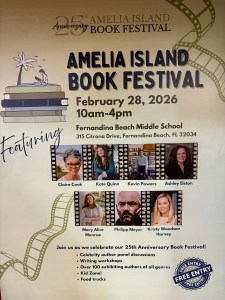
The 5 sessions:
- Never Too Late to Follow Your Dreams Workshop with Claire Cook
- From Page to Screen: The Art of Adaptation, featuring authors David Baldacci, Philipp Meyer, Claire Cook, and Mary Alice Monroe, moderated by Kevin Powers
- Hollywood Hustle: The Truth About Options and Development, featuring authors Kristy Woodson Harvey, Kate Quinn, and Ashley Elston
- Women’s Stories on Screen: Emotion, Place, and Power featuring authors Kristy Woodson Harvey, Mary Alice Monroe, Kate Quinn, Claire Cook, and Ashley Elston, moderated by Madeline Martin
- American Reckonings: The Architecture of Power, War, and Legacy featuring authors David Baldacci and Philipp Meyer, moderated by Kevin Powers
Intro Workshop – It’s Never Too Late to Reinvent Yourself — Claire Cook started the morning with an incredible dose of optimism throughout her workshop. She’s currently writing her 26th book and shared a wonderful sentiment: “Dreams don’t have an expiration date.” Whether you are postponing a dream or still searching for one, Claire’s journey, walking the red carpet at 50 for her first novel to screen transition, proves the road to reinvention is open.
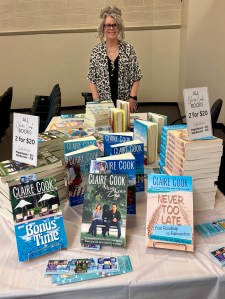
with Claire Cook and her many books
Wisdom from Claire:
- People fit into two groups: Either postponing their dreams or unsure what dreams to pursue.
- If unsure: What did you want to do before life got in the way? What were you drawn to?
- Try different things and experiment: Doesn’t have to be a paying job.
- Ride the Bus of Negativity: Tenacity is key. Sometimes it’s better to not say anything about what you attempting to silence the critics.
- Be who you really are: Be authentic and avoid chasing trends.
- Confound expectations: Put a surprise in everything you do and be original.
- Do something nice: Many times this helps in unexpected ways.
- Get your act together: Often challenging, today many things can be learned via free online videos.
- The power of consistency: Write 2 pages a day, 7 days a week. Simple, but powerful.
- Her advice books: Never Too Late: Your Roadmap to Reinvention and Life Glows On: Reconnecting With Your Creativity
Panel 1: From Page to Screen: The Art of Adaptation –Next, a powerhouse panel moderated by novelist Kevin Powers, featured David Baldacci, Philipp Meyer, Claire Cook, and Mary Alice Monroe. They all discussed the transition from the solitary act of writing a novel to the collaborative and often chaotic world of film. Each author on the stage brought a unique perspective on what happens when a story leaves the writer’s desk.
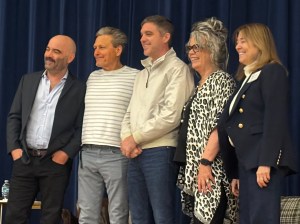
L to R: Philipp Meyer, David Baldacci, Kevin Powers, Mary Alice Monroe, and Claire Cook
Kevin Powers, the moderator, has lived the book to film experience with his novel, The Yellow Birds. He has other novels out, with his latest, Children of the Wild, releasing in June. Not only is Kevin a gifted poet and novelist, he’s also an Iraq War veteran who understands the emotional core of a story.
David Baldacci has had many novels adapted, including Absolute Power, Wish You Well, The Christmas Train, and One Summer, which became films. King & Maxwell is a TV series. His novels 6:20 Man, Memory Man, and Atlee Pine are under development. David reflected on the 30-year legacy of his first adaptation, Absolute Power. This was his debut thriller, and seeing it turned into a film starring and directed by Clint Eastwood in 1997 set a massive bar. He spoke about the unthinkable abuse of power at the heart of that story, and seeing those stakes amplified on the big screen.
David’s advice for writers: Research is key, but don’t dump everything into your book. Some writers research for thirty years but never write a single page. Life is chaotic, and novels should reflect that. Set the mood and atmosphere through research and historical settings.
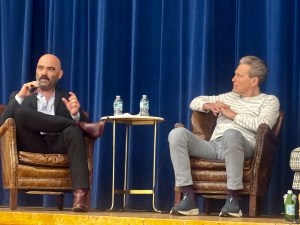
L to R: Philipp Meyer, David Baldacci
Philipp Meyer’s book to film transition was streamlining a “long-form” experience. His Pulitzer-finalist novel The Son became a TV series starring Pierce Brosnan. (I highly recommend it!) His multigenerational epic spanned 160 years and had to be compressed into a TV series while keeping the story intact. Both of his books were adapted, and location tax credits were key. He was involved in adapting The Son but not for American Rust.
Phillip’s advice for writers: Write about something you don’t really understand. He’s learned how to do things in every book. Some days he’s in the flow, while others are a grind. Start with a voice and story ideas. Then figure out why it’s interesting. He does a ton of research, and for one book read 300 nonfiction books! When he understands the world of the story, he is done with the research. His first drafts are unreadable, even though he starts with an outline and revises as he goes.
Mary Alice Monroe has written 30 books for adults and children. Her novel, The Beach House, is a Hallmark Halll of Fame movie, starring Andie MacDowell. Other books are under option.
Mary Alice’s advice for writers: Books can influence people. She has included pelicans, whales and monarch butterflies into her plots. If you have an idea for a story and are dying to tell it – write it! Your stories will disappear when you go, so it’s important to share your ideas and legacy. The best part of writing books is getting to learn from each one. Your primary character may be unlikable and flawed. It’s fine to start out with the shitty first draft and revise later. She prefers having some structure with her key plot points identified.
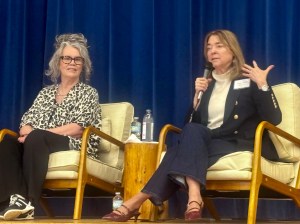
L to R: Claire Cook and Mary Alice Monroe
Claire Cook’s 2002 debut novel became the 2005 rom-com classic film Must Love Dogs starring Diane Lane and John Cusack. She touched on the hilarity and the “disastrous mismatches” of the dating world that resonated just as much on screen as they did on the page.
The common thread? Collaboration and compromise. Whether it’s changing the ending to fit a 90-minute film or adding new material to fill a TV season, the “final product”—the casting, the red carpets, and the changes—is a separate beast from the book. Writers own their book, but once a story is optioned for the screen, it belongs to a new team of creators.
Panel 2: The Hollywood Hustle: Options and Development — Kate Quinn, Kristy Woodson Harvey, and Ashley Elston, all with projects in the pipeline, shared their experiences about selling rights and the challenges they encountered along the way.
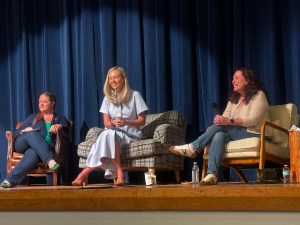
L to R: Kate Quinn, Kristy Woodson Harvey, and Ashley Elston
Key Takeaways:
- The Waiting Game: Selling an option is just the beginning; navigating scripts and press announcements takes patience.
- Pipeline Realities: Not every optioned book makes it to the screen, but the “hustle” is part of the modern author’s journey.
- Format: Mini-series can be a better fit since more of the book can be filmed than in a shorter two-hour film.
Panel 3: Hollywood Bound: Women Stories on Screen – Emotion, Power and Place — The energy stayed high with an all-female panel featuring Ashley Elston, Mary Alice Monroe, and Claire Cook, moderated by novelist Madeline Martin. They delved into why women-centered stories resonate so powerfully with modern audiences.
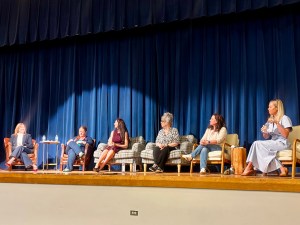
L to R: Mary Alice Monroe, Kate Quinn, Madeline Martin, Claire Cook, Ashley Elston, and Kristy Woodson Harvey
Kristy Woodson Harvey has written a dozen novels, with many under option or in development. Her female characters, living in small Southern towns, often decide what to do without a clear right or wrong.
Mary Alice Monroe focuses on ordinary relationships, but heroic decisions are often made by women. This includes older and often overlooked women. The setting is key, especially for her book about dolphins. Her novel The Beach House was made into a movie with others in development or under options.
Kate Quinn has published many historical novels. She usually starts with a female character who has often done something extraordinary in history. Hollywood seems surprised when movies with a female lead are successful. Historical settings can make it more difficult to transition to film. In the past, women often lived in an unfair world and were constrained from birth. But when a war and crisis come along, women are often allowed to do more.
Claire Cook always wanted to be a writer but postponed it. Must Love Dogs was her debut novel with a sudden film deal. She writes for female readers so they can plug into someone they know. For setting, she believes a few brush strokes are enough and focuses on what the characters go through
Ashley Elston wrote many young adult books before turning to adult fiction. She lives in Louisiana, which is like a character, and sets her novels there. Her debut adult thriller First Lie Wins was optioned.
The consensus? It’s all about the emotional truth. Whether it’s the coastal charm of Mary Alice’s The Beach House or the relatable chaos of Claire’s Must Love Dogs, readers and viewers are hungry for authenticity and stories that celebrate women stories and the strength of female bonds.
Panel 4: The Grand Finale – American Reckonings: The Architecture of Power, War, and Legacy — The last panel of the day was also moderated by novelist Kevin Powers, with David Baldacci and Philipp Meyer sharing insights.
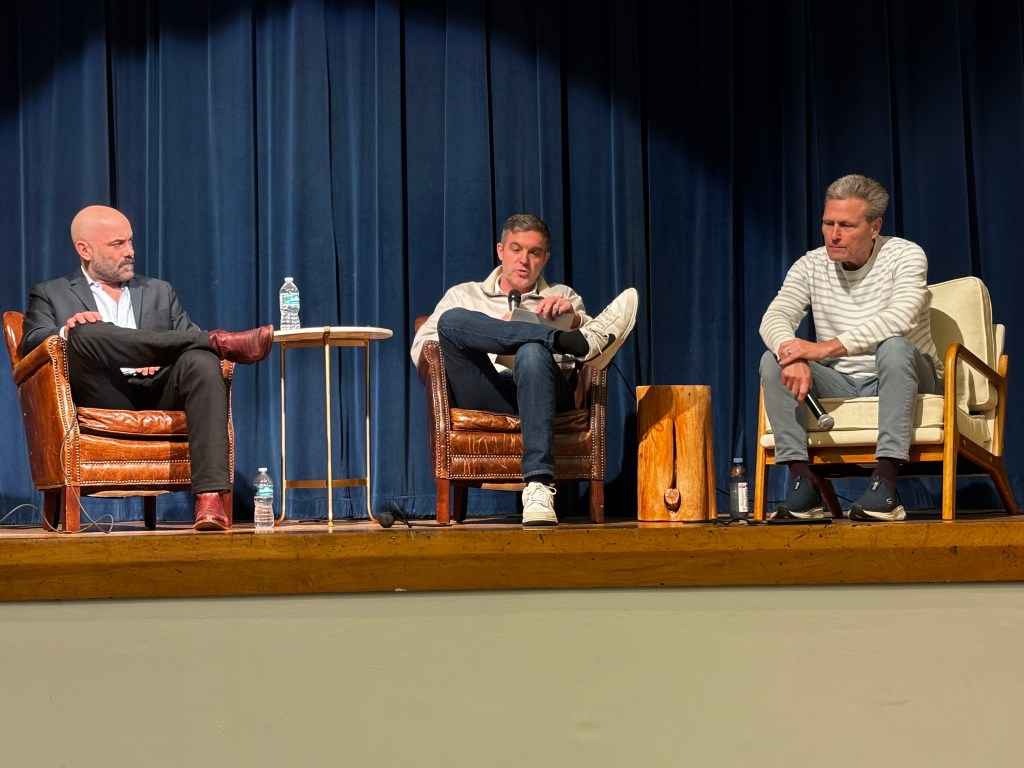
L to R: Philipp Meyer, Kevin Powers, and David Baldacci
David Baldacci talked about how all good stories start with the characters and follow the lead character through the story. All characters are both bad and good, and he enjoys writing the villains. Authors’ feelings become a part of their novel. Writing is a very personal thing, and it affects the brain. A personal touch is key and can be more frail than expected.
He wants to bring something important into his books and believes every reader interprets books differently. Reading a book can help you learn and build empathy. In real life, people can’t return to past or travel into the future. They also can’t peek into other people’s lives which is what a novel can provide.
David also mentioned how AI intelligence was built by feeding it countless books and novels. Reading more books will make humans smarter too. His book The Winner about how to win the lottery was from his imagination, but someone tried it. Books can light up your life. Our experiences are finite while books can provide that extra insight on how to deal with our real-life situations. If he was to write one last nonfiction book, it might be an update to All I Really Need to Know I Learned In Kindergarten.
Philipp Meyer shared that The City, his third book in his trilogy along with The Son and American West, will be published next year. He believes you must show both sides of humanity. Such as in Nazi Germany and the contrast between the North versus the South in the USA. Some things are wrong in the world. He writes on the darker side but wants readers to understand his dark characters and sympathize with them.
Phillipp mentioned how some people from his high school turned to crime. War, poverty, and one bad decision can ruin your life. But most people try to do the right thing, and some stories are like a mythological or historical character. He does tons of research, but it doesn’t all end up in his books. If he wrote one last nonfiction book, it might be about World War II.
It’s A Wrap — As the 25th Amelia Island Book Festival wound down, I wanted to read the books which inspired or will become a motion picture (as the Oscars call them) or a TV show or movie. Amelia Island may be small, but our literary community and the authors it attracts to its festival are world-class.
What to Read and Watch from Each Author (in Alpha Order)
David Baldacci – King & Maxell
Claire Cook – Must Love Dogs (and film) and Life Glows (nonfiction)
Ashley Elston – First Lies Win
Kristy Woodson Harvey – Under the Southern Sky
Madeline Martin – The Librarian Spy (not optioned yet but hopeful)
Philipp Meyer – American Rust
Mary Alice Monroe – The Beach House
Kevin Powers – The Yellow Birds
Kate Quinn – The Alice Network (under development)
Have you seen or read any of these authors’ books or movies? What do you recommend? Let us know in the comments.
I’d hoped the novelist John Grisham, an Amelia Island snowbird, would make an appearance. He’s written three novels that take place right here in what’s called the Camino Island series. But he’s probably hard at work, completing another guaranteed bestseller.
I didn’t see a save the date for next year’s book festival, but here’s their website. I’ve been to three, and they’ve been on a Saturday in late February. Hope to see you there! https://www.ameliaislandbookfestival.org
Novelist Karen Stensgaard lives on Amelia Island year-round with dreams of her books one day hitting the silver screen or TV. Her next book became a trilogy and should be published this year. The story is about American consultant hired by a Danish client to help recover her art from a Swiss Bank, but things go wrong from the start. The trilogy is her love letter to Denmark after so many visits, living there for a year, and a lot of research into World War II. She plans to pitch the story to Danish production companies.
 KAREN STENSGAARD